


Sustainable Plantation Farmland Investment Near Bangalore for Long-Term Income & Growth.
Deepa spent twelve years working in the sustainability ecosystem of Bangalore first as a consultant. Then as the ESG leader of a large IT firm.
When Deepa started thinking about investing she had one rule. She was not putting her money into something that makes the planet worse. Whatever Deepa invested in it had to make environmental sense.
Deepa had discussed this with her advisor, who had recommended farmland as a good investment option. Though Deepa had always known that the environmental impact of farming was an issue it was only when Deepa visited Ecovara near Lepakshi, where 15 acres of land had been converted into a mixed plantation of coconut, mango, teak, neem and 60 other species that Deepa realized something Deepa had not expected.
This is not a piece of land with trees growing. This is a functioning ecosystem. It just happens to be a financial investment.
Deepa bought a plot of land that day.
This guide is for investors like Deepa, who want their money to grow earn and make a difference that will last for generations.
Why Sustainable Farmland Is Becoming a Serious Investment Category
For most of India’s investment history the words "sustainable" and "profitable" were never discussed together. Green investments were for people who had the means to forgo a degree of profitability for a conscience.
That’s no longer the case. It’s not because of a shift in values. It’s because of a shift in economics.
Agricultural land is appreciating in India’s growing corridors. In fact it’s appreciating more than any other asset class. The tax benefits for income including zero income tax, capital gains tax and no wealth tax make it one of the most efficient investment vehicles. And as more and more urban Indians begin to realize that they want to own something of substance the demand for land is increasing.
Sustainable plantation farmland is where all of these trends intersect. You own a piece of land that’s appreciating. You earn tax- income from a productive asset.. The asset that you own is actually improving, building soil, sequestering carbon and creating ecological value that financial assets can never replicate.
This is not a charity. This is an investment thesis that just happens to align with the direction that the world is moving
What Makes Farmland Sustainable. Why It Matters for Your Investment ?
The term sustainable is used rather loosely. Here is what it means in practice for your farmland investment. Why each of these components is important for your long-term investment value.
Biodiversity and Mixed Plantation
A monoculture plantation consists of thousands of trees of a variety planted in neat rows. This is a form of plantation because a single pest, disease or climatic change can wipe out a whole crop. Mixed plantations by their nature are more resilient because if one type of tree is impacted others will continue to thrive.
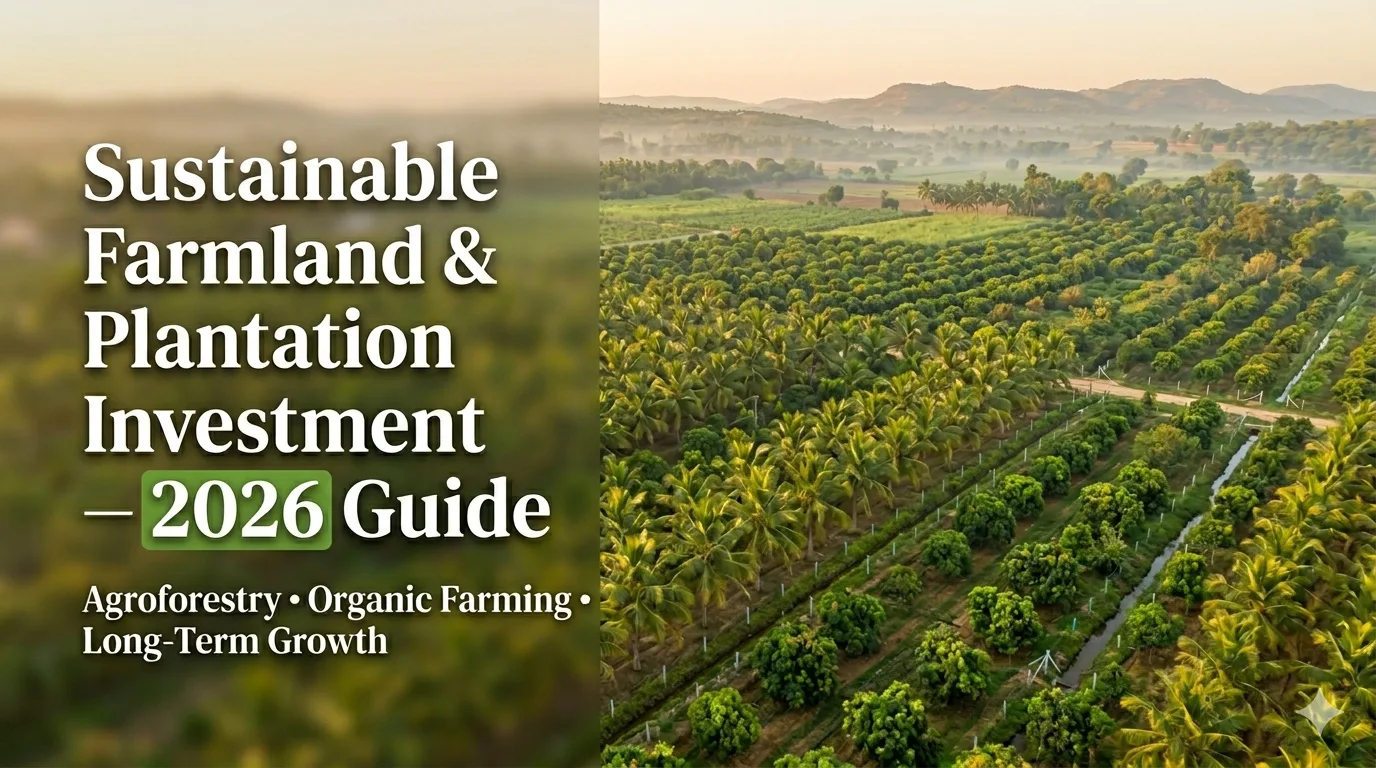
The Ecovara plantation has 64+ tree varieties on its 15-acre plot. Coconut and mango trees form the mainstay of income generation. Other species include teak, neem, sandalwood and fruit trees. This is an approach for several reasons. Your income is not dependent on a crop doing well.
Soil Health
Healthy soil is the basis for farmland. Depleted soil, arising from chemical farming over-irrigation and bare land leads to crop yield, higher production costs and consequently reduced land value and productivity over time.
Sustainable farming techniques, like the use of farming, minimal chemical application, crop rotation and land cover build soil health over time. Land under farming for 10 to 15 years is more productive and valuable than land under chemical farming for the same period
The depth of the importance of soil quality in farmland is in how to assess the health of the soil to purchase and what good soil management entails in a managed plantation.
Water Management
Water is the critical input for Karnataka’s agriculture and it is the most constrained. Karnataka has seen rainfall variability over the last decade and land without access to water is land without access to income. Sustainable water management means using drip irrigation, not flood irrigation. Drip irrigation can reduce water consumption by 30 to 50% while maintaining or improving crop yields. Sustainable water management means using borewells without depleting the water table. Sustainable water management means rainwater harvesting using monsoon rains during the season. Ecovara’s entire plantation is on drip irrigation with access to borewell water. One of the checks that an investor in farmland often fails to conduct is the availability of water on the land.
Carbon Sequestration
Trees consume carbon dioxide. A mature plantation fixes sizable amounts of carbon which helps in climate change mitigation as the tree grows and earns money at the same time.
India’s carbon credit market is in its stages but is growing. Landowners of land with verified plantations have a great opportunity to take part in carbon markets as they advance. This is not an income opportunity but it is a real option with no cost for the land investor.
The Plantation Investment Models. What You Can Own Near Bangalore
Not all plantation investments work the way. Here is a clear breakdown of the models available near Bangalore and how each generates value.
Coconut Plantation
Coconut is the backbone of Karnatakas commercial plantation agriculture and the primary income-generating species at Ecovara.
Growth timeline : Coconut trees planted from seedlings take 5 to 7 years to reach maturity. At Ecovara the existing trees are already mature. Bypassing this waiting period entirely.
Annual yield: A healthy mature coconut tree in Karnataka produces 80 to 100 coconuts annually under managed conditions. With irrigation, quality inputs and professional management this yield is reliable and predictable.
Market demand: Coconut has consistent domestic demand. Consumed as fresh fruit, copra, coconut oil, coconut water and processed products. Price volatility is lower than other plantation crops.
Productive lifespan: A coconut tree remains productive for 60 to 80 years. Investing in a coconut plantation today means income for generations. Not just for your own investment horizon.
Mango Plantation
Mango is Indias commercially significant fruit crop and Karnatakas Alphonso, Totapuri and Banganapalli varieties are among the most valued nationally.
Seasonal income: Unlike coconut which produces year-round mango generates seasonal income during the harvest period. Typically March to June in Karnataka. This seasonal cash flow complements coconuts year-round production.
Premium varieties: Specialty mango varieties command price premiums in urban markets. Ecovaras plantation includes varieties suited to both volume and premium pricing.
The lifestyle dimension: There is something satisfying about owning trees from which you can pick mangoes for your own family on a weekend visit. Several Ecovara owners cite this as one of the experiences they did not expect to value.. Now value enormously.
Agroforestry. The Integrated Model
Agroforestry is the practice of growing trees and crops in the same land mutually promoting the growth and productivity of one another.
In the context of managed land in and around Bangalore agroforestry would imply the cultivation of timber trees like teak, silver oak and eucalyptus along with fruit trees and other crops grown at ground level. The timber trees help in capital appreciation over time. The fruit trees generate medium-term income. The other crops generate short-term income
It’s not a neat and beautiful model from a natural resources point of view; it’s also a very sophisticated financial model. It’s like running three financial models simultaneously in the same land.
Tree-based farming investment in and around Bangalore includes all aspects of agroforestry like what combination of trees works best in the state of Karnataka and what kind of returns can be expected over time.
Organic Farming Plots
Organic Farming Plots In addition to the plantation sites there are also managed farmland projects like Ecovara that include organic farming plots where owners can grow their own foodstuffs, like vegetables, herbs, turmeric, ginger and other produce.
The plots have two benefits.
Soil carbon is really important. When soil is healthy and has a lot of carbon it does a job of holding onto water helping roots grow and bouncing back from bad weather. Using farming methods to build up soil carbon is good for the environment and good for your wallet too.
The North Bangalore and NH44 Belt has a climate. The area around Lepakshi and NH44 where Ecovara's has a pretty stable climate for farming because of where it is located. This makes it different from parts of Karnataka. If you are thinking of buying farmland you need to consider how well the area can handle climate change. There is a guide that can help you compare how different areas, around Bangalore will be affected by climate change
The ESG Investment Case. For Investors Who Think About These Things
From being a reporting standard for companies ESG has become a real investment consideration for many Indian investors. This is especially true for IT professionals in and around Bangalore who are exposed to ESG discussions and are interested in responsible investments.
Sustainable plantation farmland around Bangalore scores high on all three aspects of ESG.
The environmental benefits are clear. The 64+ species plantation is currently sequestering carbon. The drip irrigation system uses 40% water than neighboring conventional farms. These are not projections. They are facts that can be observed on the ground today.
Social benefits include providing employment for the local farming community around Lepakshi and Hindupuram. The local supply chain support also circulates value in the local rural economy. The presence of Ecovara in the Lepakshi corridor adds value to economic activity in a way that purely financial investments cannot.
Governance is strong with title, transparent documentation, registered ownership and professional management with regular owner communication. The governance standards that Novara Nature Estates applies to Ecovara are the standards that a serious ESG investor would demand from any asset.
The two green investment guides through farmland and green asset investment through farmland look at this opportunity from another perspective.
Smart Farming Technologies. How They Improve Your Investment
Investing in farmland may sound romantic. The best-managed farms in the Bangalore area are increasingly using technology to improve yields, lower costs and increase the owners understanding of how their investment is performing.
Smart farm technologies are advancing rapidly in India. The adoption of these technologies within managed farmland projects is a differentiator between successful projects and those that are not.
Key Technologies
- Drip Irrigation and Soil Monitoring
- Remote Monitoring and Owner Updates
- Pest and Disease Management
Drip irrigation systems water trees at the roots reducing water usage by 30 to 50% compared to traditional flood irrigation. This method can be used with soil moisture sensors to automate watering.
With GPS-tagged maps of plantations photos of progress records of harvests and communication through platforms Bangalore investors can get a precise view of their property without visiting the location each month.
Early detection of pests and diseases through monitoring allows for intervention before damage occurs. In a managed project monitoring is not a reactive measure .
Ecovaras Plantation Model. What 64+ Tree Varieties Actually Means
Ecovaras 64+ tree variety plantation is not a marketing number. It reflects an approach to building a resilient, diverse and productive farm ecosystem.
The plantation composition at Ecovara includes:
- Primary income species: Coconut and mango
- Timber species: Teak, silver oak and other growing hardwoods
- Medicinal and specialty species: Neem, moringa, tulsi and others
- Fruit variety: Guava, papaya, jackfruit and seasonal fruit varieties
- Shade and support species: Trees chosen to provide canopy cover and support growth
This composition means Ecovaras plantation is genuinely diverse. Ecologically, commercially and in terms of investment timelines.
Sustainable Farmland vs Other Investment Options
vs Residential Real Estate
The value of a flat depreciates over time while the land appreciates. In the case of managed plantation farmland plots the land is owned directly. The plantation appreciates over time.
vs Conventional Agricultural Land
Agricultural land is often barren, complex and without infrastructure. Sustainable managed farmland is developed, clear infrastructure-ready and improving with farming practices.
Financial Green Investments
Green bonds ESG mutual funds and sustainable investment funds provide exposure to ESG-themed companies. Sustainable plantation farmland provides ownership of a physical asset that sequesters carbon supports biodiversity and produces agricultural income.
Frequently Asked Questions About Sustainable Farmland Investment
1. What does "sustainable farming" actually mean at a project like Ecovara?
For Ecovara it means using inputs where possible drip irrigation, diverse plantations and farming techniques that improve soil quality.
2. Does the mixed plantation reduce my income compared to a single-crop farm?
Write your paragraph here…
No it diversifies income. The coconut provides an income while the mango provides a concentrated income during the season.
3. Can I participate in carbon credit schemes as a farmland owner?
The voluntary market in India is developing. Landowners with tree covers have good potential to enter this market.
4. How does organic farming on my plot work practically?
Organic farming plots are provided at Ecovara. The management team assists in choosing crops provides materials and manages the farming process.
5. Is sustainable farmland expensive than conventional farmland?*
A developed and sustainably managed farmland project commands a premium over raw agricultural land due to legal certainty existing plantations and management services.
6. What is the first step to owning a plot at Ecovara?
Schedule your free site visit to Ecovara today
A Final Thought on What Sustainable Investment Means
Deepa, an ESG expert from Bangalore wrote to us six months after purchasing a plot in Ecovara. She said that standing on her plot and feeling the connection to the earth and environment is the tangible connection she has made to environmental investment in her professional life. The coconuts are a bonus.
This is what sustainable farmland, around Bangalore really is: earth that is growing, producing and improving under your ownership.
Explore Ecovara farm. Schedule your free site visit.

